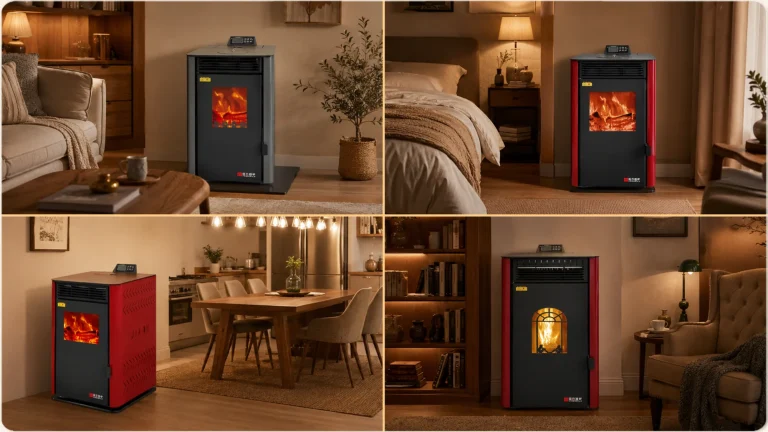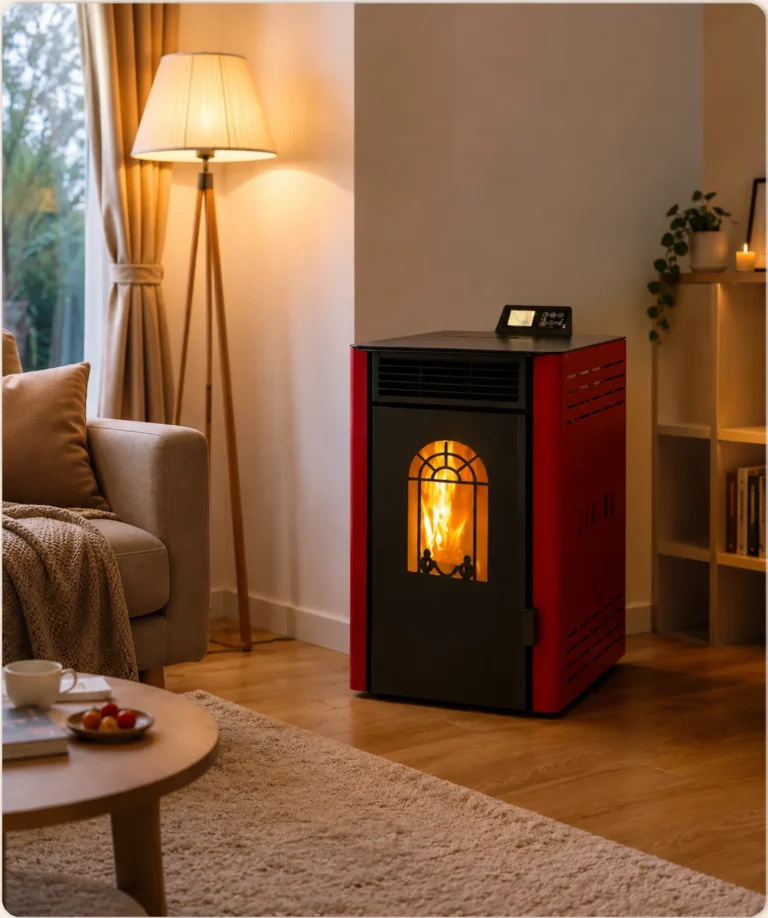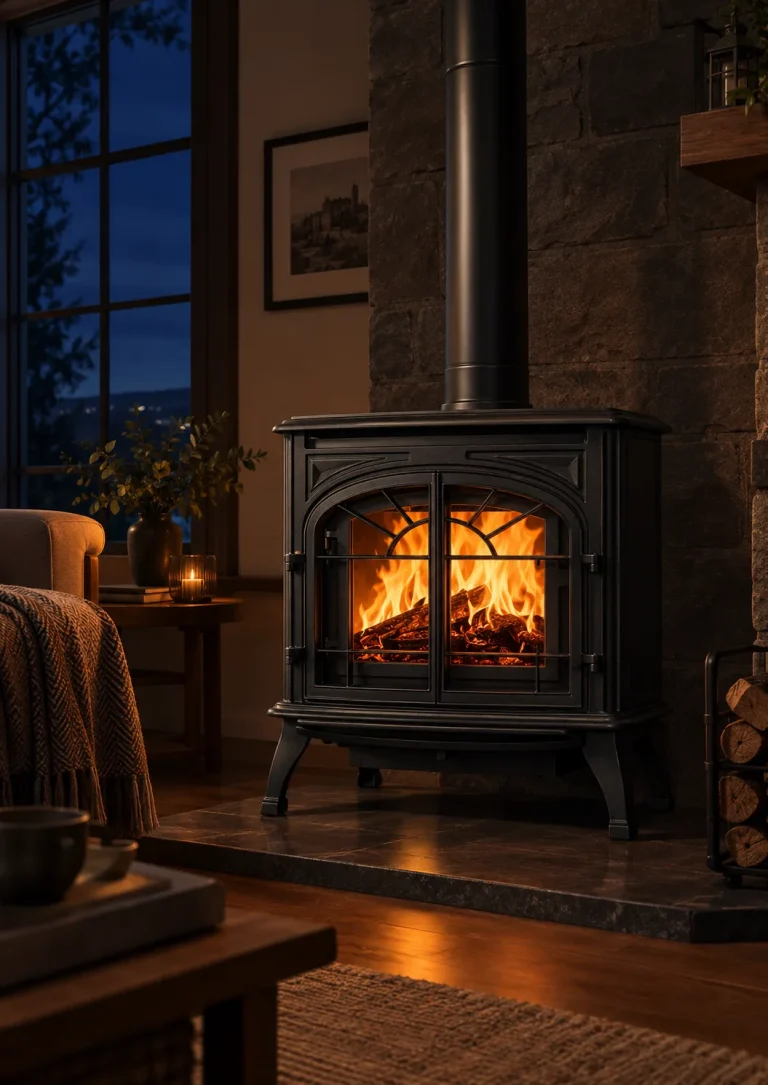
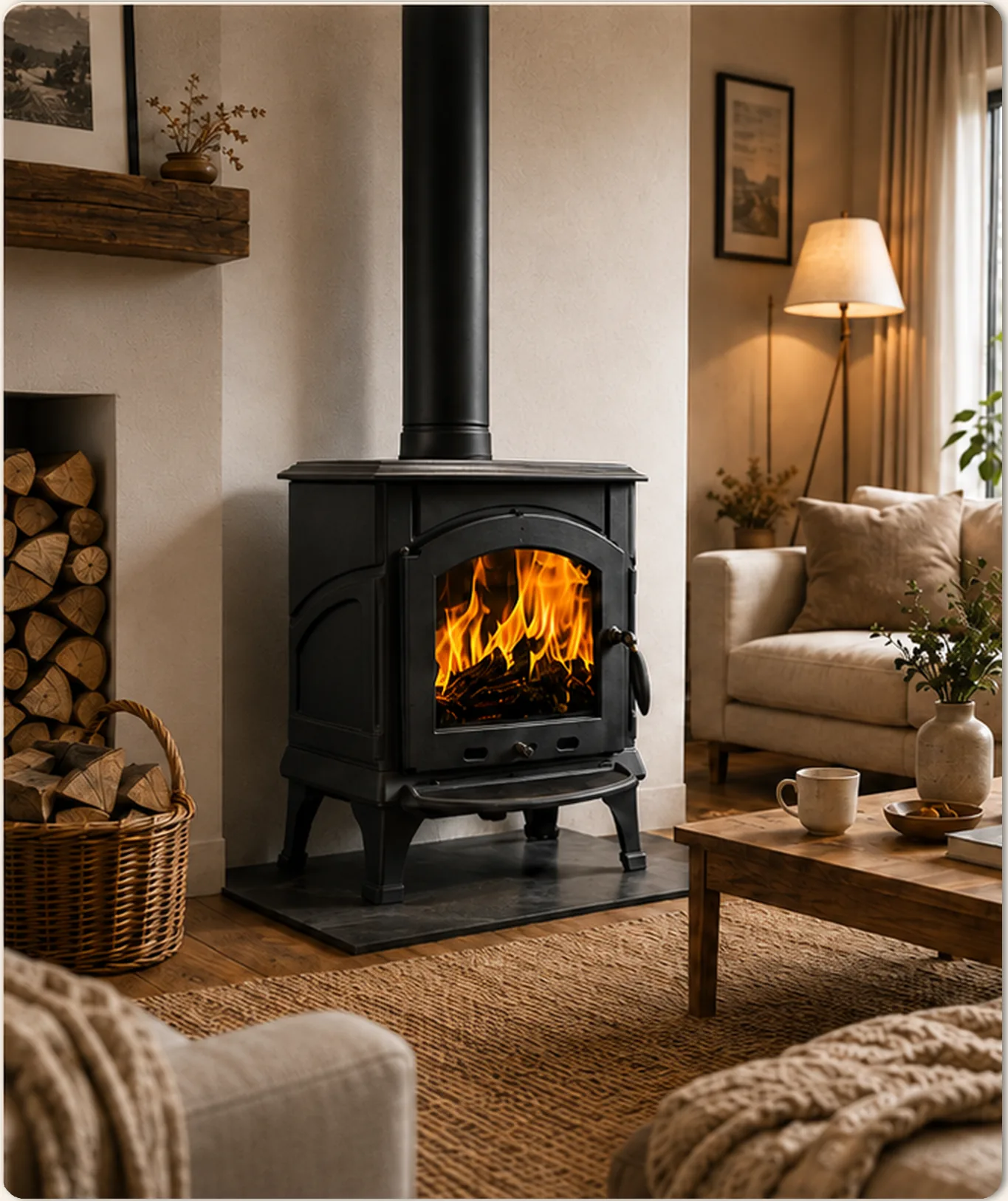
The cast iron vs steel wood stove question comes up in almost every showroom conversation. Both materials make durable stoves that burn well when they are designed, installed and used correctly. The real differences lie in how they are made, how they behave once lit, how they age, how they look and where they sit on the price list. This guide on the cast iron vs steel wood stove choice gives retailers a clear, honest way to explain those differences and to match each customer to the right stove.
In this article
We build both. Our Vesta cast iron wood stoves and Vesper steel wood stoves are developed side by side, so this is not a sales pitch for one material. It is the explanation we give our own distributors when they plan a range.
Cast iron vs steel wood stove: how each one is made
Cast iron: poured, machined and assembled
A cast iron stove starts as molten iron poured into sand moulds. Each panel, door and frame is cast separately, cleaned, then machined where parts must meet precisely. The panels are bolted together, and the joints are sealed with stove cement and heat-resistant rope. Because the shape comes from a mould, raised patterns, curves and decorative details cost little extra once the pattern exists.
This also explains why cast iron collections change slowly, an often overlooked point in any cast iron vs steel wood stove comparison. A new mould is a real investment, so good designs stay in production for years. For a dealer that is useful: spare doors, grates and panels remain available, and the model you sold five years ago still looks current in the catalogue.
Steel: laser-cut, bent and welded plate
A steel stove is built from flat plate. Sheets are laser-cut to shape, folded on press brakes and joined by welding, today often with welding robots for consistent seams. The body is one welded shell rather than a set of bolted panels, so there are fewer joints to seal. The firebox is then lined with vermiculite or refractory panels that protect the steel and keep combustion temperatures high.
Plate construction makes new shapes quick to develop. Changing a height, adding a log store or widening the glass mostly means a new cutting program rather than a new mould. That is why steel ranges tend to follow interior trends more closely. For a retailer weighing a cast iron vs steel wood stove range, it means steel can refresh the showroom faster, while cast iron provides the stable core.
Heat-up, heat retention and the feel of the heat
This is where customers expect the biggest cast iron vs steel wood stove difference, and where the most myths live. Cast iron and steel have broadly similar specific heat per kilogram. What changes the behaviour is mass, wall thickness, the firebox lining and whether the stove is built to radiate or to convect.
Radiant behaviour and thermal mass
Cast iron panels are usually thicker than steel plate. More mass takes longer to warm up, so the room feels the heat later, but the stove also keeps releasing gentle radiant warmth after the flames have died down. Customers often describe it as a soft, even heat. It suits rooms that are lived in all evening, where the fire burns for hours.
Convection behaviour and fast response
Steel bodies with thinner walls react faster. They feel warm within minutes of lighting, which suits weekend houses, rooms used for a few hours, or customers who light the stove after work. Many steel stoves also use a double skin or side panels that create convection channels: cool air enters low, warms against the body and leaves at the top, moving heat further into the room.
In practice, the cast iron vs steel wood stove choice on heat is about rhythm rather than total warmth. Neither material creates heat; the wood does. The material only shapes how quickly that heat arrives and how long it lingers. Explaining it this way avoids promises the stove cannot keep.
Durability and maintenance
The cracking myth
Durability is the second big cast iron vs steel wood stove topic. Customers sometimes hear that cast iron cracks. Cast iron is hard but less tolerant of sudden thermal shock and impact than steel. A sound casting in normal use does not crack. Cracks usually follow abuse: severe overfiring, throwing water on a hot stove, a heavy blow to a door, or a casting fault that a proper inspection should catch before shipment.
Warping in steel
Steel bends rather than breaks. Its typical failure mode under repeated overfiring is warping, often of baffles or thin internal parts. A full vermiculite or refractory lining, a correctly sized stove and sensible fuel loads prevent this. Warping is a usage problem far more often than a material problem, which is a useful point for the sales conversation.
Gaskets, rope seals and joints
Both stove types rely on rope seals around the door and glass. They compress and harden over time, and replacing them every few seasons keeps air control precise. Cast iron adds panel joints sealed with cement, which may need inspection and resealing after many years. Steel has welded seams that rarely need attention. Either way, stocking gaskets, glass and vermiculite turns maintenance into repeat business.
- Burn only dry, seasoned wood and avoid overloading the firebox.
- Check door and glass rope seals each season; replace when they flatten.
- Inspect firebox liners and grates; replace cracked vermiculite panels.
- Never cool a hot stove with water or open the door wide on a roaring fire.
- Have the chimney swept as often as local rules and use require.
Design possibilities
Design is often what really settles a cast iron vs steel wood stove decision. Cast iron excels at character. Moulded panels allow relief patterns, curved legs, arched doors and the classic silhouettes many buyers picture when they think of a wood stove. Machined cast iron doors also close with a satisfying, precise feel that customers notice in the showroom.
Steel excels at clean lines. Laser cutting enables crisp edges, tall formats, wide panoramic glass, integrated log stores and add-ons such as a baking oven. Our VS 3, for example, places a baking oven above the firebox, a format that would be costly to cast. Steel also takes custom RAL colours easily under a high-temperature coating.
Weight, installation and transport
Weight depends on design as much as material. A compact cast iron stove such as the VT 1 weighs 103 kg, while larger Vesta and Vesper models reach 185–190 kg. The firebox lining adds noticeable mass to steel stoves, so it is wrong to assume steel is always the lighter choice.
For installation, any stove of this weight needs a floor that can carry the load, plus a non-combustible hearth where required. Timber floors may need checking by the installer. For logistics, robust export packing matters for both, but cast iron is less forgiving of drops. Wooden pallets, foam and reinforced cartons protect doors, glass and castings.
Price positioning
There is no fixed rule that one side of the cast iron vs steel wood stove debate is cheaper. Price follows size, wall thickness, glass area, finish and features. Broadly, entry-level steel stoves can be very competitive because plate is efficient to produce, while premium steel designer stoves can cost more than classic cast iron. Cast iron often sits in the mid to upper range because of casting and machining work.
For a retailer, the useful move is to offer both materials at overlapping price points. Then the conversation is about the customer’s home and habits, not a budget barrier that pushes them towards one material by default.
Margins also depend on what follows the sale. Both stove types generate accessory and service income: flue kits, hearth plates, gloves, fire lighters, seasonal gasket replacement and glass. Positioning the cast iron vs steel wood stove choice as a long-term relationship, not a single box, protects margin when customers compare prices online.
Cast iron vs steel wood stove: comparison table
Use this table as a showroom summary of the cast iron vs steel wood stove differences. It describes typical behaviour; individual models vary with size, lining and design.
| Factor | Cast iron wood stove | Steel wood stove |
|---|---|---|
| Construction | Cast panels, machined and bolted, joints sealed | Laser-cut plate, folded and welded shell |
| Heat-up | Slower; mass must warm first | Faster; warm within minutes |
| Heat after fire dies | Longer, gentle radiant warmth | Shorter, unless heavily lined or clad |
| Heat character | Mainly radiant | Radiant plus convection in many designs |
| Typical risk under abuse | Cracking from thermal shock or impact | Warping from repeated overfiring |
| Long-term maintenance | Rope seals; occasional joint resealing | Rope seals; welded seams rarely need work |
| Design strength | Classic, decorative, relief detail | Modern lines, large glass, modules |
| Colour options | Mostly black and classic tones | Wide range, custom RAL easier |
| Best fit | Long evening burns, classic interiors | Short burns, fast heat, modern interiors |
Which customer suits which stove?
Ask about habits before you talk about materials. Two questions do most of the work: how many hours a day will the stove burn, and what does the room look like? The answers usually point clearly to one side of the cast iron vs steel wood stove decision.
Customers who suit cast iron
- Families who light the fire in the afternoon and keep it going all evening.
- Rustic, country, classic or period interiors.
- Buyers who value a traditional look and a heavy, solid feel.
- Homes where lingering warmth after the fire dies down matters.
Customers who suit steel
- Weekend and holiday homes that need fast heat on arrival.
- People who light the stove for two or three hours after work.
- Modern, minimal or Scandinavian-style interiors.
- Buyers who want large glass, a log store, an oven or a custom colour.
Showroom checklist for retailers
- Ask how long and how often the stove will burn each week.
- Ask for the room size, insulation level and layout before choosing a model.
- Show one cast iron and one steel stove of similar size side by side, so the cast iron vs steel wood stove comparison is physical, not theoretical.
- Let the customer open and close both doors to feel the difference.
- Explain heat rhythm honestly: fast response versus lingering warmth.
- Mention care: dry wood, no overfiring, seasonal gasket checks.
- Confirm floor load, hearth and flue diameter with the installer.
- Offer spare parts and an annual service visit at the point of sale.
Sizing matters as much as material. An oversized stove of either type ends up burning at low air, with sooty glass and poor combustion. Our guide on how to size a wood stove covers the heating-area method step by step.
How CREPUS Vesta and Vesper map to this
The Vesta collection is our cast iron line, named after the Roman goddess of the hearth. It covers rooms from 50–60 m² (VT 1) up to 100–120 m² (VT 3), with machined cast iron doors and frames, a 152 mm flue outlet, and options such as the VT 4 side-opening loading door. Vesta suits the classic, long-burn customer.
The Vesper collection is our steel line, built with laser cutting and robotic welding. It covers 80–100 m² (VS 3 with baking oven) up to 150–200 m² (VS 2), with clean lines and wide glass. Both collections share refractory or vermiculite-lined fireboxes, an airwash system for clear glass, primary and secondary air control and a high-temperature coating rated up to 600 °C.
Test reports and declarations for relevant standards, such as EN 13240, are available on request for qualified models. Rules on emissions and installation vary by country, from the EU Ecodesign regulation for solid fuel heaters to national and local rules, so check the current official texts and work with a qualified installer.
Bottom line for retailers
Neither material wins outright. The cast iron vs steel wood stove decision is a match between material and lifestyle: cast iron for slow, steady, classic warmth; steel for fast response and modern design. Showing both, explained honestly, builds trust and lifts conversion. Staff who can explain the cast iron vs steel wood stove trade-offs in two minutes sell with more confidence, and customers return for spare parts, service and their next stove.
If you are planning a balanced range or a mixed-model container, contact our export team or explore our solutions for distributors and retailers. We reply within one business day.
Frequently asked questions
Is a cast iron or steel wood stove better?
Neither is better in every case. In a cast iron vs steel wood stove comparison, cast iron usually warms up more slowly and holds heat longer, giving gentle radiant warmth that suits long evening burns. Steel responds faster and allows cleaner, modern designs with large glass. The right choice depends on how often the stove burns, the room size and the interior style.
Does a cast iron wood stove crack easily?
No. A sound cast iron stove in normal use does not crack. Cracks are usually caused by thermal shock or impact, such as throwing water on a hot stove, severe overfiring or a heavy blow to a door. Burning dry wood, avoiding overloading and letting the stove cool naturally protect the castings for many years.
Does a steel wood stove warp?
A well-built steel stove with a full vermiculite or refractory lining should not warp in normal use. Warping typically follows repeated overfiring, oversized fuel loads or burning without the liners in place. Choosing the right size and following the manual on loading and air settings are the most effective ways to prevent it.
Which heats a room faster, cast iron or steel?
Steel usually heats a room faster because thinner walls warm up quickly and many designs add convection channels. Cast iron has more mass, so it takes longer to warm but keeps radiating heat after the fire dies down. For short burns, steel feels more responsive; for long burns, cast iron gives steady, lingering warmth.